
There are moments in childhood that look very small from the outside. A few lines on a piece of paper. A tower made from blocks. A crayon held a little more steadily than yesterday.
But to a child, those moments can feel enormous.
Fine motor skills grow through exactly these small everyday moments. Every time a child scribbles, squeezes, stacks, pours, buttons, or builds, those little hands are becoming stronger and more coordinated — often without the child even realizing they are learning.
1. Let Them Scribble
Before children learn to write letters, they first learn to make marks. Dots, circles, long lines, short lines — and sometimes wonderfully enthusiastic scribbles that seem determined to escape the page entirely.
Holding a crayon, pressing it against the paper, changing direction, and moving the hand with purpose all help develop the muscles and coordination children will later use for handwriting.
There is no need to turn every drawing session into a lesson. Give them paper, give them colors, and let their hands explore.
2. Play With Dough
Rolling, squeezing, pinching, flattening, twisting, and pulling play dough are wonderful exercises for small hands. Children may think they are simply making snakes, cakes, animals, or imaginary food, but their fingers are getting stronger with every movement.
You can make it even more playful with tiny challenges: roll a long snake, make small balls using only the fingertips, pinch spikes onto a dinosaur, or hide a few safe objects inside the dough and let your child find them.
The activity does not need to look educational to be educational. Often, some of the best learning happens while children simply believe they are playing.
3. Build, Stack and Connect
Blocks, interlocking bricks, puzzles, and construction toys ask children to coordinate their eyes and hands in surprisingly precise ways. A block needs to be turned, a puzzle piece rotated, and two pieces carefully lined up before they connect.
These simple actions strengthen hand-eye coordination while encouraging children to experiment, solve problems, and try again when something does not work the first time.
And when the tower falls for the fifth time and they begin building again, they are developing something else too: patience.
Not every fine motor activity needs a worksheet. Sometimes, a pile of blocks on the floor is doing far more learning than we realize.
4. Tear, Stick and Create
Tearing paper may look simple, but it asks both hands to work together while the fingers control the direction of each tear. Add glue, stickers, or collage pieces, and suddenly children are practising several fine motor movements in one playful activity.
Let them tear colored paper, peel stickers, squeeze a small amount of glue, and arrange the pieces however they like. The finished artwork does not need to look perfect — and it probably should not.
A creation that clearly looks like a child made it is often far more meaningful than one an adult quietly “fixed” along the way.
5. Scoop, Pour and Transfer
Some of the easiest fine motor activities are already hiding in the kitchen. A spoon, two containers, and something safe to transfer can become a simple activity that keeps little hands busy and learning.
Children can scoop, pour, and move dry pasta, large beans, water, or age-appropriate small toys using spoons, cups, tongs, or scoops. These movements strengthen hand control while building coordination and concentration.
Yes, sometimes things will spill. That is part of learning too.
6. Encourage Everyday Independence
Buttons, zippers, shoes, lunch boxes, containers, and backpacks are all little fine motor challenges hiding inside an ordinary day.
When adults are in a hurry, it is often much faster to do these things for children. But whenever time allows, give them the chance to try first. That extra minute spent wrestling with a zipper or opening a container is not wasted time — it is practice.
And when they finally manage it on their own, notice that little look of satisfaction. Independence grows through these small victories, one attempt at a time.
7. Celebrate the Effort, Not Just the Result
Children notice how adults react to what they create. We do not need to celebrate every scribble as if it belongs in a museum, but we can show genuine interest in the effort behind it.
Simple responses can mean a lot: “You worked really hard on that.” “You used so many colors.” “You kept trying until it worked.” Or simply, “Show me how you did it.”
These small moments tell a child that the process matters, not just the finished result. And little by little, that builds something even bigger than hand strength: confidence.
A Little Story Behind “Small Hands, Big Skills”
Many years ago, when my son Muhammad was still a little boy, we were living in Bradford, England. At the time, I was taking an English course while Muhammad spent part of his day at nursery. When my course finished, I would go to pick him up.
A lovely caregiver named Sue worked there. I still remember how, some days, she would greet me with such genuine happiness and pride and say:
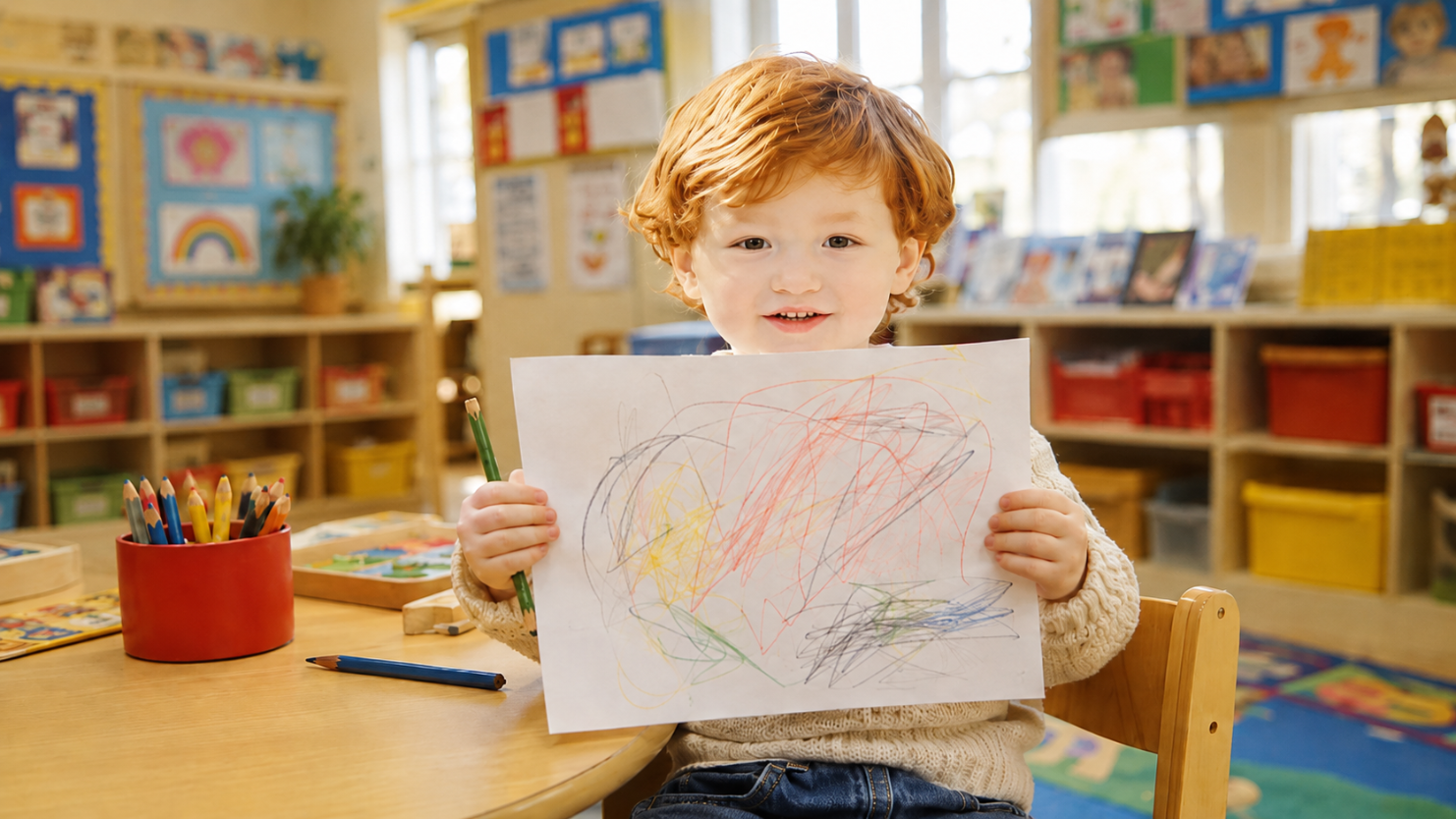
Inspired by Muhammad’s little-hands years — when scribbles felt like a big achievement. ❤️
“Look what Muhammad has done!”
Then she would show me his work. Sometimes, to an adult eye, it was simply a page covered with colorful scribbles. But when I looked at Muhammad, I saw something completely different. I saw the pride in his eyes, the happiness on his face, and that wonderful little smile of a child who knew he had made something all by himself.
Those scribbles may have looked small to me, but to Muhammad they were not small at all. They were an achievement. They were his.
Today, Muhammad is 31 years old, and in just three months, he will become a father himself. Sometimes I think about those days in Bradford, about that little nursery, about Sue’s warm voice, and about the pride in Muhammad’s eyes over something as simple as a page of colorful scribbles.
And I cannot help wondering if, very soon, Muhammad will live that same moment with his own child. Maybe one day he will look at a few little marks on a page and feel exactly what I felt all those years ago: that small hands are never doing something small. They are learning, growing, trying, expressing, and quietly building confidence one little movement at a time.
That is the heart behind Small Hands, Big Skills. It is not only about preparing children to hold a pencil or strengthen their fingers. It is also about honoring the beauty of small beginnings, celebrating effort, and seeing childhood achievements through the eyes of love.
Sometimes, what looks like “just scribbles” to the world can mean everything to a child. And when we slow down enough to notice that, we give those little hands something even bigger than practice — we give them pride, joy, and the feeling that what they do matters.
“Perhaps that is the quiet wonder of parenthood: the little hands we once held eventually grow beyond our reach, only to one day reach down—with all the love we once gave them—and hold a new little hand of their own.”